
Ghibli Tourism Video | AI for Video

Updated: Dec 3, 2025
Introduction: Trust me this is a tutorial...
Any person prognosticating about AI will likely end up eating their words. Whether they downplay its scalability/quality or conversely, overstate its current capabilities while predicting a utopian AGI future, both commentators are equal in their wrongness.
This constant debate isn’t helped by the persistent viral content that showcases the ever increasing library of Generative AI apps and comparisons between the worst 2 year old Generative AI outputs and today’s highly curated results.
But before we get into the tutorial I think it is important to restate my intent for my website's AI blog series:
Organize and structure my approach to learning about AI.
Demonstrate my understanding of the technology, tools, workflows, and vendors delivering these innovations.
Research the open-source communities actually developing the tech that gets repackaged and sold to us by these fly-by-night AI startups.
To provide insight on if these AI workflows are even worth it.
Tutorial: Creating a Ghibli-Style Tourism Video
The paths to producing AI content are now pretty well-worn and weren't all that complicated to begin with, and it feels like the responsibility for generating good outputs increasingly falls on the companies and open source developers curating their own unique recipe of stable diffusion. So unfortunately even if you are using ComfyUI or downloading and running your own models off of Hugging Face it's not really up to us if any of this comes out good or not.
I bet now you’re thinking, "We’ve really lost the plot here." Where is the tutorial?
Hold on a minute.. let's start with the inspiration for this project:
It all stems from this video: Travel Oregon - Only Slightly Exaggerated.
In the spring of 2019, I saw this video, long before Generative AI or even COVID was a twinkle in your father's eye, and it floored me. As a motion graphics designer, I was fairly confident in my skills but my biggest insecurity was and still is illustration and frame-by-frame animation.
And that wasn't helped after I saw this...
The Travel Oregon Video is simply put a triumph. Even now, I have to watch it through parted fingers because it’s humbling to know I’ll never create something this exquisite.

This tourism video is both beautiful and thrilling, the result of artists dedicating their lives to mastering their craft. They combined time, skill, and money to handcraft something truly outstanding.
When I saw it I seethed with jealousy; I couldn’t stop thinking about how talented the creators of this commercial must be.
So, when Generative AI began to improve, I immediately thought, Maybe now I can create a video like this. Maybe (though I lack the raw talent) I could invest time into crafting prompts and directing AI to produce something comparable. Maybe prompting is a just another skill to learn and thus master.
And the most surprising thing? I sort of can... but to have pride in what I produced would be a bit humiliating to put it mildly.
I am sure my output would be better if I spent more time rolling the dice in Midjourney or paying for more tokens to run more AI video outputs but that aside the results are frankly mediocre.
They certainly don’t rival the Travel Oregon Video but they’re “good enough.”
That being said, I am not an AI hater nor am I an AI apologist, I am an AI realist as well as a computer enthusiast so I am just going to call it how it is...and how it is — is it's bad in a good sort of way?
So how do you make this kind of AI video?
Well, you probably already know how to do it; you go to Midjourney, type in your city name, and then write something like “in the style of a Miyazaki Ghibli film.”
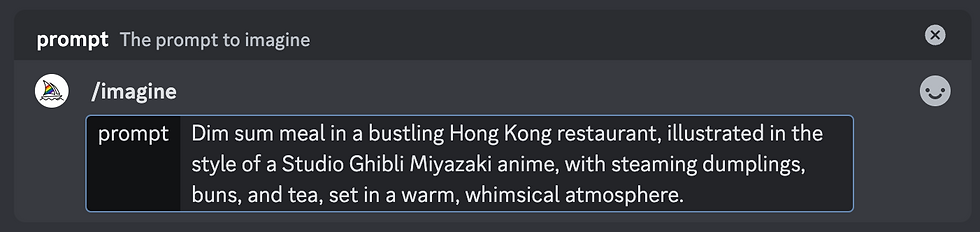
Once you find an image that works, you head over to tools like Lumalabs.AI, Runway.ML, or maybe Kling if you want a bit more control.
From there, you write a simple animation prompt—rippling water, swaying trees, or drifting clouds—and then cut it all together in an editor on top of some bespoke AI music from Suno.
With that introduction and overview behind us here is the procedural:
1. Generate Images in Midjourney:
To reiterate use prompts like "[Iconic City Landmark] in the style of Studio Ghibli/Miyazaki anime illustration."
For this example I used Victoria Harbour, Hong Kong
Experiment with the prompts with a focus on landmarks and natural scenery.
After generating the images, pick outputs that came out the best and have the least amount of errors.
When prompting focus on vignettes that are iconic to your city.

2. Animate Scenes with Lumalabs.AI or Kling:
Import your chosen images.
Use prompts that are subtle, like I mentioned before I used keywords like, rippling water, moving clouds, or swaying trees.
Tools like Kling's Motion Brush provide greater control for animators but honestly I haven't noticed much of a difference in terms of getting desired outcome.
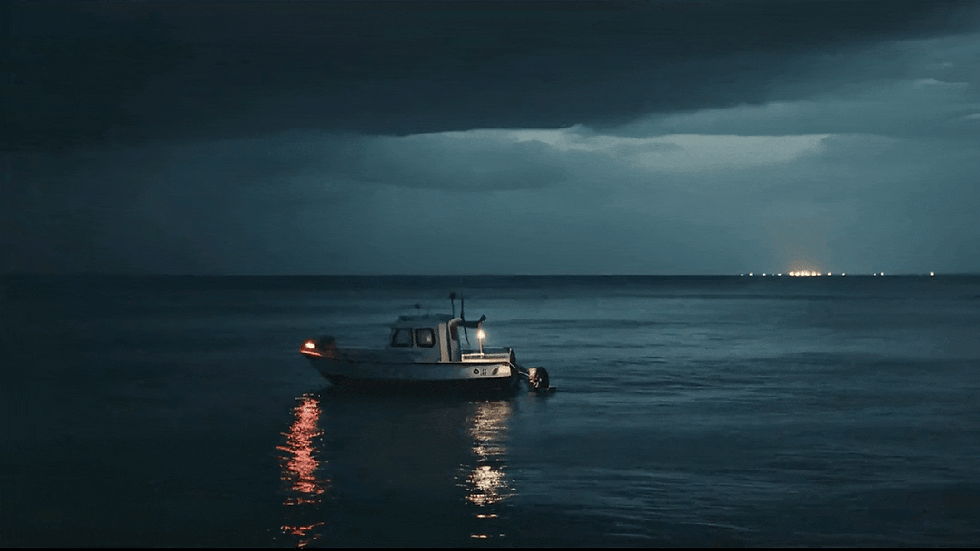
3. Fine-tuning After Effects & Photoshop:
Adding parallax in After Effects with the AE Camera
Separate the foreground from the background using the pen tool in After Effects to create depth by moving those elements independently in "z" space and pushing an AE camera through them.

Use Photoshop's Generative Fill to fix little details in an otherwise decent output

4. Assemble in Premiere Pro:
Cut the best clips together in an editing software of your choice I personally use Premiere Pro
Use Suno to generate some bespoke AI music
Prompt: A calming, sentimental piano piece inspired by the style of Studio Ghibli, evoking the quaint charm of a vacation in Hong Kong.
I suggest Suno because they offer an uncharacteristically generous free plan of 50 credits that renew daily which come out to 10 songs a day at the time of this writing.
This process results in a certainly...interesting but essentially saccharine, low-effort piece that will likely be dismissed as AI slop.
That being said, we need to pick the right kind of project. Trying to do our own version of the Travel Oregon Video was setting us up for failure. If we leverage this for smaller campaigns this becomes a bit more acceptable and quaint.
Below is an quick example using the same technique but instead of trying to edit a whole video I focused on a simple instagram post for a hypothetical café.
It might not match the quality of professionally animated works, but for personal projects or smaller campaigns, it's still...
..."good enough”
Stay With Me Here: The Era of "Good Enough"
I keep saying this is "good enough"—why?
A lot of technology I feel is "over" before it truly begins. Take the World Wide Web or its more common misnomer “The Internet”: nearly every type of website we use today was created within the first decade of the internet's existence.
Some might point to Arpanet (1969) or the World Wide Web’s beginnings at CERN in 1989 as the starting points for the internet, but I just think they're wrong.
I think a military and scientific research tool that DARPA and CERN developed isn't exactly the same animal as our modern day internet. No, the modern internet begins with entrepreneurs taking the smattering of computer networks that cropped up during the 60s, 70s and 80s and turning them into a mainstream consumer product.
To compare this with AI — what is a more useful starting point for a modern discussion about AI and it's implications? The development of The Perceptron? or the release of ChatGPT?
So where does the internet, as we know it, really begin? For me, it’s 1993 with AOL email.
This was the turning point, a time when the internet became accessible to everyday people, requiring no technical expertise and offered through a simple subscription service.
The biggest companies today—Google, Amazon, Facebook—emerged from the crowded field of late-1990s and early-2000s competitors. Yet we often overestimate the lasting influence of early giants like Yahoo, MySpace, and AOL. While they had their moments, much of their reign overlapped with the rise of "new guard" companies like Facebook and Google.
Consider Google, which still feels like the “new kid on the block.” Yahoo launched in 1994, and Google followed in 1998. While it took some time for Google to overtake Yahoo, they both started at virtually the same point. We are talking about a 27 year old company versus a 31 year old company, is it really that big of difference?
What about streaming video? You might think it took longer to materialize, but it didn’t. YouTube launched in 2005, just 8 years after AOL introduced AIM in 1997. To put that in perspective, TikTok launched 12 years after Facebook — YouTube launched exactly 12 years after AOL email (1993) my chosen year for the "modern internet."
Not to mention, Newgrounds had been hosting Flash animations and live-action video content since 1995. Take the Numa Numa Video, for example—we often associate it with early YouTube, even though it was first hosted on Newgrounds.
What I’m trying to drive home is that the narrative that platforms like MySpace, AOL, and Yahoo belong to the “old internet,” disrupted by newer players like Google and Facebook, isn’t entirely accurate. These companies were all born around the same time and did functionally the same thing; while some survived and others didn’t.
In many ways, the internet arrived fully formed with HTML and the World Wide Web. The last 30 years have mostly been about optimisation; refining user experience, speed, and reliability.
Even Amazon, now a towering e-commerce giant, was once dismissed as just another “Yahoo-esque” failure of the "old guard" before its dominance solidified.
When it comes to AI, I see the same pattern emerging. We’re entering the era of "good enough." AI development has reached a point where tools are widely accessible, workflows are well-established, and most possible outcomes are achievable with basic prompting.
But the field is crowded with too many products that are essentially the same. The technology has already reached its logical conclusion, and now we’re entering the “consolidation phase.” A few AI companies will merge, legacy app developers will buy up AI product suites and bundle them with their licenses, and as the ROI on training models shrinks, the field will stop improving.
Further the problems AI started with are still very much present. Quality remains inconsistent, details are often poor, and it typically performs well only within specific art styles. Guiding it toward a specific style or maintaining consistency with characters/environments is at best challenging and at worst damn near impossible.
It is design as a form of lottery or sheepherding.
Much like AI now during the Dot-com Bubble, many internet start-ups tried to convince investors that the internet had an unimaginable future, filled with limitless potential.
However, most practical use cases for the internet were established almost immediately. Now, after 30 years, the core functions of websites remain essentially the same: content hosting, social networking, messaging, and e-commerce. These four categories defined the internet then and still do today. Start-ups in the '90s knew this, but to gain investors they needed to market themselves as visionaries.
For example, a company might say, "We’re not a bookstore, we're a technology company." This narrative was about hype not reality, selling investors on a future that couldn't be conceived of because it couldn't possibly exist.
This is why we see such a push for AGI because Generative AI is essentially done. It hasn’t disrupted the world the way many expected.
So, if you want to know what the future looks like, it looks like now—just slightly better and a bit more refined.
Closing Thoughts:
AI feels more like a Frankenstein’s monster, stitched together from bits and pieces of human creativity and powered by vast amounts of energy unleashed by mother nature herself—only instead of a lightning bolt, it’s an atom. So considering all that, AI works best as an imperfect assistant to talented individuals, not a replacement for skill.
That being said, it’s clear how these AIs can be used—not as a replacement for human talent but as an aid.
Using the Travel Oregon Video as an example; It’s obvious to me that it probably could have been produced faster if the artists had access to Generative AI back then, without significantly sacrificing quality.
Imagine the workflow: the artists create a full storyboard from scratch, followed by detailed illustrations. Then they use Photoshop’s Generative Fill to tweak small elements and tools like Kling or Lumalabs.AI to animate portions and background elements for the final video. AI becomes a sidecar for cleanup and enhancements, a concept Adobe has clearly embraced with its AI tools.
The more I use AI, the more I see it as a middling tool that allows people more talented than me to easily make last-minute adjustments or minor tweaks to a work they already built up from scratch. For others, it’s like a slot machine art box that spits out dream-like content so surreal and odd that it really shows the contrast between art made by a person versus art made by an AI.
What I am basically and desperately trying to communicate is some kind of transformation of taste and ideas happens in a person when they embark on the labor and journey of trying to be at least a little good at something. That perspective... that taste... that intent does not exist in the author of an AI work and it shows.
So with that my broad-strokes review of this workflow would be 3 out of 5 stars. Outputs kind of mid but good for smaller campaigns especially for retail/food services.
Apps used as well as prices are as follows:
Rating: ★★★☆☆
Cost: Varying degrees of vampiric subscription models.
Apps Used:
After Effects
Premiere Pro


Comments